
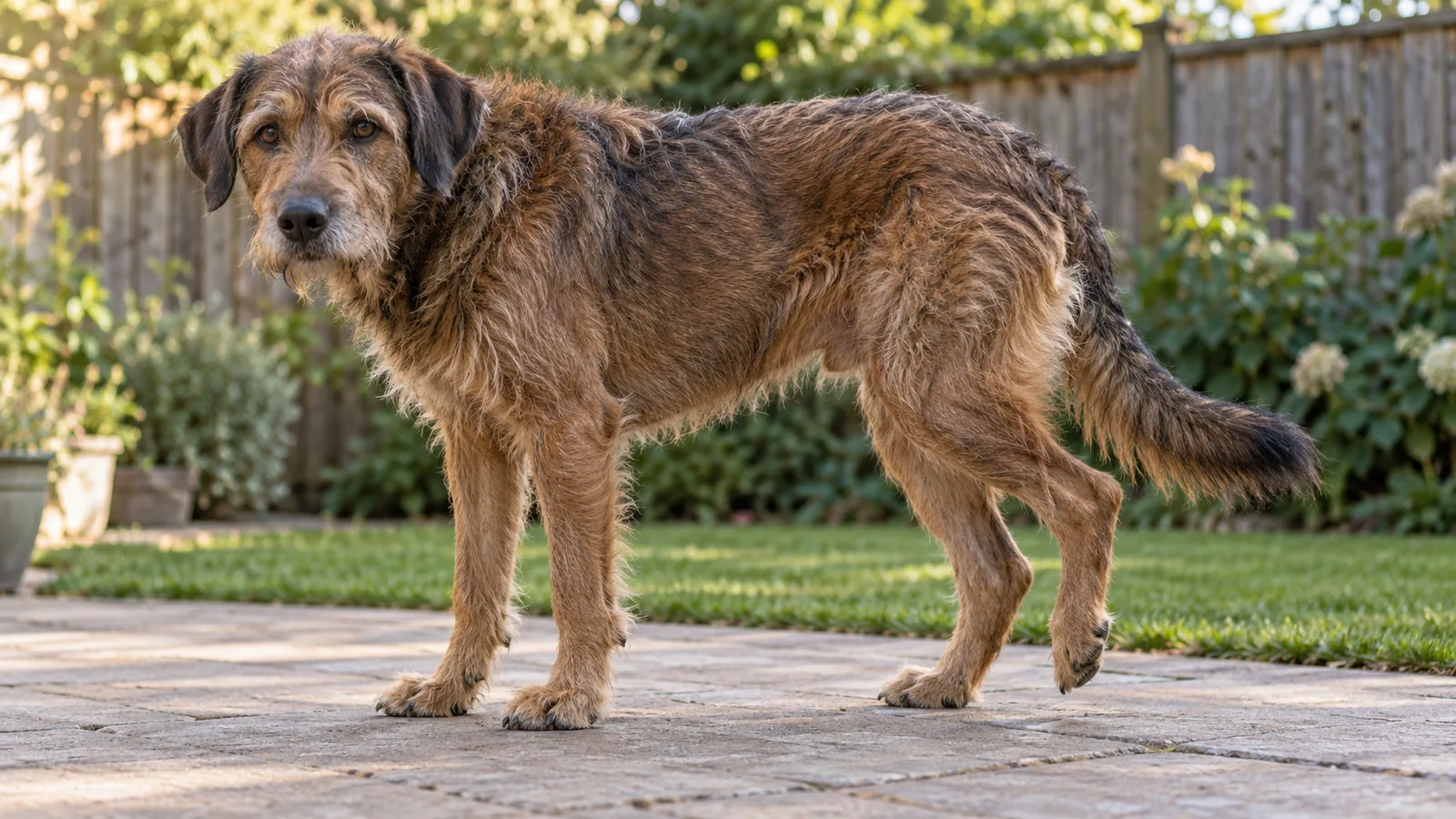
Stiffness after a hard play session is often just a sore muscle, though it can also be the first sign of a torn cranial cruciate ligament, the dog version of a human ACL. Muscle soreness fades within a day or two and does not return on its own. A cruciate tear tends to do the opposite: better with rest, lame after the next burst of running, and gradually worse over the weeks that follow. Posture gives it away too, since a dog with a painful knee often sits with one back leg swung out to the side instead of folded underneath.
Waiting is the costly part of a knee injury, because an unstable joint keeps wearing down every time your dog runs or takes the stairs. We would far rather examine your dog while you are still unsure and tell you it was nothing more than a tired muscle. Krichel Animal Hospital in Keokuk is AAHA accredited, and a careful hands-on exam of the knee plus digital X-rays show us whether the ligament is involved and what your dog's treatment options look like. If your dog is still favoring that leg a day or two later, or will not put weight on it at all, set up an exam and we will give you a clear answer.
Torn Knee Ligaments in Dogs: The Basics
- Many cruciate tears build slowly from a ligament that's been weakening for months, so there's often no single injury to point to.
- A limp that fades with rest and comes back after the next hard run is the classic early pattern, and it's worth an exam rather than another week of watching.
- A torn cruciate doesn't heal on its own, and the arthritis that follows an unstable knee is the part that's hardest to undo later.
- Surgery gives many medium, large, and giant breed dogs the best long-term function, while some very small dogs do acceptably well with rest, medication, and a careful home program.
What Sets a Dog Up to Tear a Knee Ligament?
The cranial cruciate is a band inside the knee, called the stifle in dogs, that keeps the shin bone from sliding forward each time your dog pushes off. A cruciate ligament injury usually traces back to a ligament that has been slowly fraying for months rather than a single bad landing at the park, and the fraying comes down to how that knee is built and how it gets used.
- The slope of the shin bone: its upper surface tilts backward, and the sharper that tilt, known as the tibial plateau angle, the more forward force runs through the ligament on every stride.
- Breed: Rottweilers, Newfoundlands, Staffordshire Terriers, and Labrador Retrievers are all linked to increased risk, though plenty of small dogs tear cruciates as well.
- Body weight: extra weight loads that same band of tissue all day long, and it's one of the few risk factors you can change.
- Weekend-only exercise: a dog who rests all week and then runs flat out along the Mississippi riverfront in Keokuk on Saturday asks more of a weakened ligament than one who moves moderately every day.
Once one knee goes, risk to the second climbs, since the same slope, weight, and gait are all still in play and the extra weight it’s carrying as your dog limps causes more stress to the joint.
Is This a Sore Muscle or a Torn Cruciate?
Limping that shows up after hard play, fades with a few days of quiet, then returns on the next big run is one of the most common early patterns of a partial tear. A complete tear looks different: the leg comes up mid-stride and mostly stays up. Neither pattern proves anything on its own, which is why both knees get examined by hand.
Over the following weeks, other changes creep in:
- Swelling: you can feel it on the inside of the knee when you compare one side against the other.
- Morning stiffness: the first few minutes after a nap look rough.
- Hesitation: the stairs or the jump into the car stop being automatic.
- A thinner thigh: the sore side loses bulk because your dog has stopped loading it.
- A click as your dog walks: that can mean the meniscus, the cartilage cushion inside the joint, has torn as well.
A limp isn't proof of a cruciate problem, though. A sprain, a fracture, a cut pad, hip arthritis, or in an older large-breed dog a bone tumor can all look much the same from across the room, and each one needs a different answer.
| What you notice | Sudden complete tear | Slow partial tear |
| How it starts | One hard turn or jump, sometimes with a yelp | No single moment, just soreness that comes and goes |
| The first day | Leg held up, little or no weight on it | A mild limp after activity |
| What rest does | Some weight returns, but the joint stays unstable | Limp clears, then returns on the next big run |
| Over weeks | Lameness persists and the thigh thins | Episodes land closer together and last longer |
How Do We Confirm It's the Cruciate?
Confirming a tear is mostly a hands-on job: we feel for the shin bone sliding forward against the thigh bone, a motion a healthy knee won't allow. X-rays of the stifle rule out a fracture or a bone tumor and show how much arthritis has already settled into the joint, even though the torn ligament itself never appears on the image. That visit includes:
- Your account of it: when the limp started, what your dog was doing, and whether it has come and gone.
- A video from home: a sore knee often looks better in the exam room than it does in your living room, so a video of how your dog moves at home gives us a clearer picture.
- The exam: both knees get checked for that forward slide, for swelling, and for the thickening that comes with a long-standing tear.
- Sedation when it's needed: a tense, sore dog can brace hard enough to hide the motion we're testing for, so sedation allows us to move the knee in the way that’s needed to get a diagnosis.
For complicated cases, MRI shows the meniscus and the ligament fibers themselves in a way X-rays cannot, though that's a specialty hospital service and most knees get diagnosed without it.
If your dog is limping on a back leg and you aren't sure what you're seeing, give us a call and we'll get that knee examined. We see urgent problems during our open hours, and after we close, our recording routes you to the doctor on call.
Can a Torn Cruciate Heal Without Surgery?
A cruciate ligament that has torn stays torn: the fibers don't reconnect, and the knee doesn't become stable again on its own. Rest makes your dog more comfortable without repairing anything, and every week a knee moves without a working ligament, arthritis advances a little further while the joint capsule thickens in response to the instability.
The meniscus suffers too, grinding against shifting bone until it tears, which adds a sharper pain and more work for whatever repair comes later. The hindquarters lose muscle, so a dog who limped for four months starts rehab from further behind than one repaired in week two.
- What non-surgical management involves: weeks of strict activity restriction, anti-inflammatory and pain medication, and a slow rebuilding program afterward.
- When it's a reasonable choice: some very small dogs, where less force crosses the joint, and any dog whose other health problems make anesthesia a poor risk.
- What you give up: for many medium, large, and giant breed dogs, a repaired knee works better over the long run and develops arthritis more slowly than one managed with rest.
- What makes it hard: strict confinement is tougher than it sounds, and dogs tend to re-injure the leg on the days they seem fine.
Our veterinarians will weigh your dog's size, activity level, and overall health, then tell you honestly whether that trade makes sense.
One rule with no exceptions: never give your dog human pain medication. In dogs, ibuprofen, naproxen, and acetaminophen can each cause stomach ulcers, kidney injury, or liver damage, sometimes after a single dose. Call us for something safe instead.
Which Cruciate Repair Will My Dog Need?
Three repairs cover nearly all cruciate surgery in dogs, and the right one turns on size, age, activity level, and the slope of that shin bone. Which of the three fits comes down to the measurements a doctor reads off your dog's stifle X-rays, and that reading also settles whether the repair gets scheduled at our AAHA-accredited hospital or with an orthopedic surgeon, so the plan gets set at the exam rather than over the phone; keep your dog leashed on every trip outside until then.
How Do TPLO, TTA, and Extracapsular Repair Differ?
TPLO surgery changes the angle of the tibial plateau so the knee holds itself steady during weight bearing instead of depending on the ligament that tore, which is why it suits athletic and large-breed dogs so well. It’s the most recommended surgery, but there are other options available that are chosen based on your dog’s age, size, breed, and lifestyle.
| Repair | How it works | Often chosen for |
| TPLO | The top of the shin bone is cut, rotated to level the slope, and held with a plate | Active, large, and giant breed dogs, and steep tibial plateau angles |
| TTA | The bony attachment of the kneecap tendon is advanced forward to cancel out the forward force | Many of the same dogs, depending on anatomy and the surgeon's judgment |
| Extracapsular repair | A strong suture outside the joint does the ligament's job while scar tissue builds | Smaller dogs and less active dogs |
The meniscus gets inspected during any of the three, and a torn piece is trimmed while the joint is open. Many dogs go home the day after surgery with an incision to protect, pain medication on board, and a two-week stretch when almost nothing is allowed.
What Does Recovery After Surgery Look Like?
Recovery runs on a schedule rather than on how good your dog looks. Staged rehabilitation brings back the thigh muscle lost during the limping weeks and restores the range of motion the joint gave up.
A typical plan opens with leash walks for bathroom breaks only and cold packing the knee, then moves into short walks that lengthen week by week plus gentle flexing and extending on the floor at home. From there it widens to hills, longer outings, and eventually off-leash running once the surgeon clears it. Sit-to-stands, slow figure eights, and stepping over a line of low obstacles build the back end without stressing the repair, and dedicated rehabilitation centers add underwater treadmills. Our laser therapy and pain management can help with sore joints and healing soft tissue along the way.
How Do You Keep a Recovering Dog Comfortable at Home?
Most of the first two months happens at home, and the setup there is what protects the repair: a nonslip route from the crate to the door and a resting space your dog can't launch out of. Call us if the incision opens, swells, or starts draining, or if your dog suddenly stops using a leg they had been using well.
How Do You Keep a Dog Settled Through Crate Rest?
Boredom, not pain, is what drives many dogs to test the rules of crate rest, so the setup matters as much as the confinement. Put the crate or pen in the room where your family spends its evenings, and give the day a predictable rhythm of meals, puzzle toys, and short leashed potty breaks. Frozen stuffed toys, snuffle mats, lick mats, and nose games with treats hidden under cups tire a dog out without moving them much, and teaching a new trick like chin resting or touch counts as a brain workout without the physical risk. For a dog who paces, cries, or climbs the pen walls, anti-anxiety medication can be the difference between resting and re-injury. If that's where you are by week two, check in with us and we'll look at both the pain plan and the setup.
How Do You Protect This Knee and the Other One?
Keeping your dog lean is the lever you control every day, since each extra pound adds to the force crossing that knee with every stride. Five minutes of warm-ups and cooldowns around activity lets muscle and ligament take on load gradually instead of absorbing it cold.
- Grip underfoot: runners on tile and hardwood, plus a mat at the bottom of the stairs, keep a back end from scrambling.
- Ramps instead of jumps: the leap off the tailgate or the back of the couch is the move that undoes a repair.
- Steady exercise: two moderate walks a day beat an hour of ball launcher sprints on Saturday.
- Write it down: note how long your dog walked and how they move the next morning, then bring that to the recheck.
What Dog Families Ask About Cruciate Repair
How long before my dog walks normally again?
Many dogs put real weight on the leg within a couple of weeks of surgery and walk comfortably by eight to twelve weeks, with a full return to running usually somewhere around four to six months. Dogs managed without surgery follow a slower and less predictable curve. Muscle comes back more slowly than bone heals, so the thigh can still look thin at month three even when your dog feels great.
Is a senior dog too old for cruciate surgery?
Age alone doesn't rule out knee surgery. What matters is heart and lung function, kidney and liver values, body condition, and how much that bad knee is shrinking your dog's life. We recommend bloodwork before anesthesia, plus an EKG when a heart rhythm needs a closer look. Plenty of senior dogs come through cruciate repair well, and an unstable joint left alone can take mobility away faster from an older dog than a younger one.
Does a knee brace work instead of surgery?
Braces help a specific group: small or low-activity dogs, and dogs who can't safely be anesthetized. A custom-fitted brace worn consistently can take some load off the joint, but it doesn't stabilize things the way a repair does, and an ill-fitting one rubs sores into the leg within days. For an active medium or large breed dog, a brace is usually a way to manage pain and buy time, not a substitute for surgery.
Let's Examine That Leg and Weigh Your Options
If your dog is favoring a back leg, or you're partway through recovery and wondering how that joint is holding up, schedule a visit at Krichel Animal Hospital in Keokuk. We can examine the knee, take X-rays here, and walk you through what each path would mean for your own dog and where the activity plan should go next.